
If you have ever experienced back pain, knee pain, hip pain, or tight muscles, there is a good chance someone has told you to stretch.
In fact, stretching is often one of the first recommendations people receive when pain starts. Friends suggest it. Social media promotes it. Many people immediately begin searching YouTube for stretching routines hoping to find relief.
And sometimes stretching helps.
But if you have been stretching consistently and your pain keeps coming back, there is an important question worth asking:
What if tightness isn’t actually the problem?
At Seattle Rehab Specialists, we regularly work with active adults who have spent weeks or even months stretching an area that hurts, only to find that the pain never truly goes away. The reason is simple:
Pain and tightness are not always the same thing.

Why Stretching Feels Good
Let’s start with what stretching does well.
Stretching can:
- Improve short term flexibility
- Temporarily reduce feelings of stiffness
- Increase tolerance to movement
- Help you feel looser and more comfortable
For many people, stretching creates temporary relief because it changes how the nervous system interprets tension. You may feel better immediately afterward, even if the underlying issue has not changed significantly.
This is not a bad thing.
The problem occurs when stretching becomes the only solution.
The Difference Between Mobility, Flexibility, and Strength
One of the biggest misconceptions in fitness and rehabilitation is that all movement limitations are caused by tight muscles.
In reality, there are three separate factors that influence how your body moves.
Flexibility
Flexibility is the ability of a muscle to lengthen.
A hamstring stretch is a classic example of flexibility training.
Mobility
Mobility is your ability to actively move through a range of motion with control.
You may have enough flexibility to touch your toes, but still lack the mobility needed to squat, run, or golf efficiently.
Strength
Strength is your ability to control movement and tolerate load.
This is where many people get stuck.
If your body lacks strength in a certain position, it may create a sensation of tightness as a protective mechanism. In these situations, stretching the area often provides only temporary relief because the real issue is inadequate strength or control.
Why Tight Muscles Are Not Always Tight
This is one of the most important concepts we teach our patients.
Sometimes a muscle feels tight because it is actually overworking.
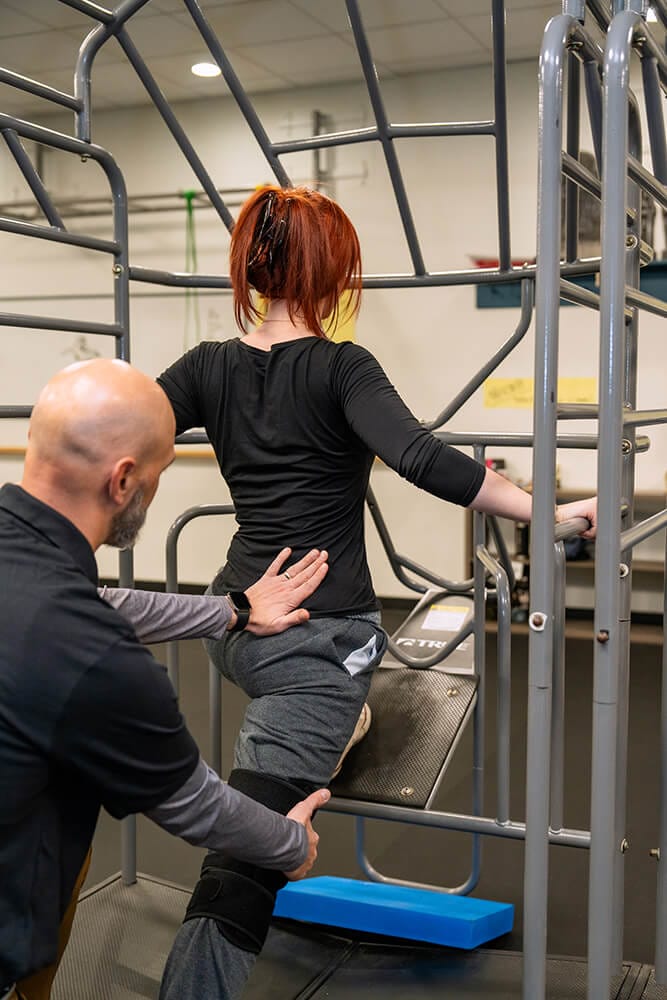
Consider someone with low back pain. Many people stretch their lower back repeatedly throughout the day because it feels tight.
However, the real problem may be:
- Limited hip mobility
- Poor core strength
- Decreased glute activation
- Excessive sitting
The lower back is not necessarily tight because it needs stretching. It may be tight because it is doing the job of other areas that are not contributing enough. Until those contributing factors are addressed, the sensation of tightness often returns.
A Real Patient Example
Sarah from Green Lake came to our clinic with recurring hamstring tightness.
She stretched every morning.
She stretched before runs.
She stretched after runs.
Yet her hamstrings always felt tight.
When we evaluated her movement, we found that her hamstrings were not the primary issue. Instead, she demonstrated limited hip strength and poor single leg control while running.
Every stride was placing extra demand on her hamstrings. The muscles were working harder than they should have been, which created the sensation of tightness.
Instead of prescribing more stretching, we focused on:
- Hip strengthening
- Single leg stability
- Running mechanics
- Progressive loading
Within several weeks, her feeling of constant tightness dramatically improved. Not because we stretched more. Because we addressed the reason her body felt tight in the first place.
What the Research Says
Research increasingly supports exercise and strengthening interventions for many common musculoskeletal conditions.
A clinical practice guideline published in the Journal of Orthopaedic & Sports Physical Therapy recommends exercise therapy as a primary treatment for many common pain conditions, including low back pain and knee pain.
Similarly, a landmark review published in The Lancet by Foster et al. (2018) found that active approaches involving movement and exercise are among the most effective interventions for persistent musculoskeletal pain.
The message is clear:
Movement matters.
Strength matters.
Load tolerance matters.
Stretching alone is often not enough.

What Should You Do Instead?
If you are dealing with persistent pain or recurring tightness, ask yourself:
- Is this area actually lacking flexibility?
- Do I have enough strength to control this movement?
- Am I moving efficiently throughout the day?
- Am I gradually exposing my body to the activities I want to do?
In many cases, the answer involves a combination of:
- Mobility work
- Strength training
- Movement retraining
- Progressive loading
Stretching may still be part of the plan. It is simply not the entire plan.
Final Thoughts
Stretching is not bad.
In fact, it can be a valuable tool.
But if you have been stretching the same area for weeks, months, or even years without lasting improvement, it may be time to look deeper.
The goal should not be to simply feel looser. The goal should be to understand why your body feels tight in the first place.
When you identify the true cause, you can build a solution that creates lasting results rather than temporary relief.
At Seattle Rehab Specialists, we help active adults identify the root cause of pain and movement limitations so they can return to running, golfing, hiking, and the activities they enjoy most.